Kategorie-Archiv: English

Exam Anxiety in Microsoft Certifications – The Human Side of MCT Training
The topic of what anxieties students face when taking their first Microsoft exam came up rather by chance at the last ‚MCT Germany Caffee-Lounge‘. This monthly exchange format for German-speaking MCTs not only focuses on the human aspects of training, but also on the challenges for trainers, the latest community news and much more. One thing became clear: one of our tasks as MCTs is to help participants overcome their exam fears – because the challenges often start with their own insecurities, not with the technology itself.

Typical Fears Before the First Exam

For many students, the first Microsoft exam is a step into the unknown. It’s not just about gaining the first certificate for a new employer – often, it’s also their first professional certificate ever, or the first Microsoft certificate they’re taking. In some cases, it’s even the first formal exam outside of school or university. This special starting point increases the pressure even more and amplifies the fear of failure. Exam anxiety doesn’t just show up as nerves on the day itself; it accompanies many candidates throughout their preparation: doubts about their own abilities, worries about incomprehensible tasks, or fears about not meeting expectations are everyday companions.

To be completely honest: I already experienced exam anxiety at primary school. I often procrastinated, didn’t participate in lessons, and at times even gave up. The lowest point was when I was moved back from year four to year three and my then class teacher told my parents that I would never amount to anything. Today I know that this had nothing to do with a lack of intelligence. Every exam situation means overcoming my fears anew – and I’ve since learnt to deal with it very well and to pass exams successfully. As a trainer, I talk openly with my students about failure but also about how important it is to get back up and keep going. That’s exactly why it’s so important to me to take my students’ concerns and anxieties seriously and to meet them with empathy.

Other Forms of Anxiety – More Than Just Exam Nerves

Alongside classic exam anxiety, other relevant forms come into play: many people fear being judged by others, whether by trainers, colleagues, or their manager. Fear of failure can cast a shadow over their whole professional future. Not infrequently, fear of technology also plays a role – for example, if there is uncertainty in handling exam software or if worries about technical problems make it harder to focus on the content. Social anxieties, such as the fear of embarrassing oneself in front of others or of asking questions, are also common and can significantly affect learning success.

Why These Fears Must Be Taken Seriously

Fears are not a marginal issue – they significantly influence learning behaviour and exam success. Those who don’t feel safe during training absorb content less effectively and are more likely to develop a block towards new topics. The consequences can extend far beyond the exam: self-doubt, resignation, or the decision not to pursue further certifications are not uncommon. This is why it’s important to recognise these fears and meet them with appreciation and respect.

The Role of MCTs – Empathy, Experience, and Sensitivity

Microsoft Certified Trainers are not only conveyors of knowledge but also mentors and supporters. Their experience in dealing with exams is a valuable resource for students – provided they approach these anxieties with empathy and sensitivity. An open attitude, sharing personal exam experiences, and a willingness to discuss insecurities create an atmosphere in which fears can be addressed and managed.

Practical Tips for MCTs – Recognising and Addressing Anxiety

  • Encourage Open Conversations: Give students the opportunity right from the start to openly discuss their fears and uncertainties – even during a casual chat at the coffee machine or over lunch.
  • Share Personal Experiences: Remain authentic as a trainer and talk about your own challenges to lower barriers.
  • Enable Small Successes: Make progress visible during training and give targeted praise to boost participants’ confidence.
  • Proactively Address Technical Hurdles: Test the exam software together and simulate exam situations to reduce technical anxieties.
  • Consider Social Anxieties: Foster a respectful group environment, avoid embarrassing anyone, and show understanding for different learning paces.

Conclusion – The Importance of the Human Component

Certifications are more than just proof of knowledge – they are often milestones in personal and professional development. MCTs have the chance to accompany this journey not only academically, but also personally. By recognising fears, taking them seriously and supporting participants with empathy, they make a crucial contribution to exam success. For students and trainers alike: success arises where knowledge and humanity come together.


Why we as MCTs should attend in-person events like local MCT Summits

AI generated image. Illustration of a lively networking event at the “MCT Summit.” Groups of people are talking and smiling in a conference hall. In the foreground, four individuals stand around a table with open laptops and charts, engaged in animated discussion. Two large banners reading “MCT Summit” hang above. The atmosphere is professional and collaborative.

Microsoft Learn is available at any time. With just a few clicks, we can meet on Teams calls, exchange knowledge, and work together on documents. So – do we really still need physical gatherings?

Yes. And more urgently than it might seem at first glance.

Because what happens at an MCT Summit can’t be packed into a recording. It isn’t “content” you can catch up on later. It’s an experience that exists only in the moment – and that’s exactly where its impact unfolds.

Encounters that last

At these summits, I’ve forged connections with international MCTs. Some I see only once a year at the MCT Summit Europe. With others, I’m in regular contact, exchanging ideas, seeking or offering advice. And then there are the encounters that happen spontaneously – over coffee, during a break, on the way to the next session. Conversations that weren’t planned but provided exactly the impulse I needed at that moment.

This year in Manchester was my second summit, after the one in the Netherlands in 2024. I met people in person whose work and contributions I had long followed – people who inspired and motivated me on my journey toward self-employment. I was especially pleased to meet Thomas this year, with whom I now bring the MCT Germany Blog to life. There were encounters with individuals whose openness and enthusiasm were contagious – and who, consciously or not, encouraged me to take new steps. And there are people I absolutely want to stay in touch with, because they enrich me both professionally and personally.

This community is more than just a network for me. It’s a circle of people I can rely on – on my path to TSP, in self-employment, and in daily learning. It supports, challenges, and encourages. And I love that!

Learning with all senses

An in-person workshop is different from an online call. You feel the energy in the room, see other participants’ reactions, hear the quiet “aha” in the second row. You can immediately follow up if something is unclear and experience how discussions develop that would never arise online in the same way.

It’s these moments when knowledge is not only conveyed but truly anchored.

Visibility and influence

Those who are present on-site get noticed. Not just by other MCTs, but also by Microsoft, by program managers, by people who influence the program, like the community leads. That can open doors – to projects, to speaking opportunities, to possibilities you never even had on your radar before.

Inspiration that lasts

After a summit, I never go home the same as I arrived. I take away ideas that reshape my approach to training. Contacts that inspire me even months later. And an energy that carries me through everyday life.

Fun fact: Our Microsoft Program Manager waited 25 years before attending their first MCT Summit – and still says that not joining sooner is one of their deepest regrets.

More than just a date in the calendar

An MCT Summit isn’t a “nice-to-have.” It’s a place where we as trainers develop – professionally, methodologically, personally. It’s a space where we share not just knowledge, but attitude, experience, and courage.

And it’s a reminder that our work isn’t just about slides and modules, but about people whom we accompany, inspire, and empower.

Check out the MCT Lounge for the planned MCT Summits for 2026.
Keep checking in – there will be more to come 🙂

Applied Skills – Why you shouldn’t focus solely on MOC courses as an MCT

ai-generated. MCTs in a room

Applied Skills are not a new exam format. They’ve been available for quite some time, but many MCTs and course participants hardly notice them or underestimate their value. Yet, they provide exactly what Microsoft and companies have increasingly emphasized in recent years: practical skills instead of pure exam knowledge are in demand and essential.

What are Applied Skills?

Applied Skills are short, time-limited, scenario-based assessments. Participants work in a preconfigured sandbox environment and solve concrete tasks within the Microsoft portal. There are no multiple-choice questions, no traditional exam sheets – but rather tasks that reflect real-world professional scenarios.

Examples:

  • Creating a Conditional Access Policy
  • Setting up an Azure Storage Account with specific properties
  • Configuring a Microsoft 365 compliance policy

Why are Applied Skills important for us as MCTs?

Many MCTs focus exclusively on MOC courses. That’s understandable – MOC courses are often the foundation of our work. But if you only know and teach these courses, you’re missing out on an important area.

Benefits of engaging with Applied Skills as an MCT:

  • You’re familiar with new exam formats and stay up to date
  • You can better support your participants in their preparation
  • You demonstrate that you don’t just understand the theory, but can also implement the topics you teach

Combined with our professional experience from real-world projects outside of training environments, these are the arguments why clients hire us as trainers instead of simply buying a video course.

What differentiates an Applied Skills assessment from a traditional certification?

  • Focus on practical implementation instead of theoretical knowledge
  • No multiple choice – real configuration in Microsoft environments
  • Shorter in scope but with higher demands on true understanding
  • Current technology applications and scenario-based requirements

Here you can find an overview of Applied Skills.

This Playbook Elevates Your Microsoft Trainings to a New Level

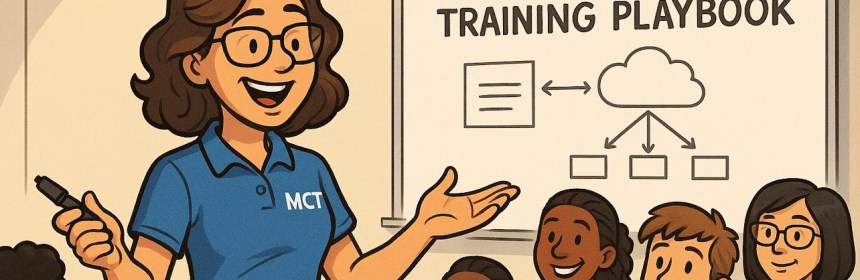
ai-generated images of a female MCT in front of a diverse class. "Training Playbook" on a whiteboard

Whoever has stood in front of a diverse learning group as an MCT (Microsoft Certified Trainer) knows the situation: different backgrounds, various learning habits, cultural nuances—and yet everyone should leave the training with a positive feeling.

This is precisely where a new Inclusive Facilitation Playbook in the MCT Lounge comes in. It’s not a dry manual, but a practical guide that helps you design your trainings to be more inclusive, accessible, and effective.

Why You Should Be Interested

The playbook collects tips, methods, and those small but crucial tricks that often make the difference between “solid” and “inspiring.” From the first greeting, through the structure of your sessions, to the use of modern tools—it’s about intentional design instead of random hits.

Experienced MCTs report that, thanks to the playbook, they have:

  • made their trainings more interactive and accessible
  • increased participant satisfaction
  • discovered new tools and approaches they could implement immediately

Without Giving Too Much Away…

Of course, the full value lies in the details—and you’ll find exactly those exclusively in the MCT Lounge. There you’ll get:

  • a clear structure you can follow before and during your trainings
  • inspiration for an inclusive mindset shift
  • impulses for more engagement, better clarity, and greater interaction flexibility

And the best part: The playbook is a living document, regularly updated. You can bookmark it, access it at any time, and benefit from the experiences of the global MCT community.

My Conclusion

This playbook isn’t just a “nice to have,” but a tool that tangibly relieves you as a trainer and boosts your impact. It encourages self-reflection and gives you ideas you can implement right away.

Curious? Then register in the MCT Lounge (for MCTs only) and take a look. It could be exactly the building block that lifts your next trainings to a whole new level.

Become a Volunteer for Microsoft Ignite & the AI Tour 2025!

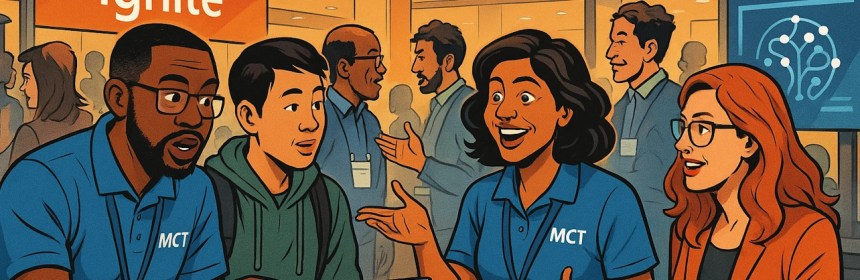
ai-generated picture. MCT trainers at a conference

Every year it’s a highlight – and now it’s that time again: Microsoft is looking for dedicated MCT volunteers for two of the biggest tech events coming up next year:

  • Microsoft Ignite 2025
  • The return of the worldwide Microsoft AI Tour

All information can be found in the official MCT Lounge blog post by Sarah:

https://techcommunity.microsoft.com/blog/mctnews/ms-ignite-and-ai-tour-volunteers/4436380 (MCT login required)

If you love Microsoft technologies, enjoy working with people, and want to be part of these unique events, keep reading – and don’t hesitate to apply!

Why It’s Worth Applying

As an MCT, you’re part of a global community that shares knowledge, empowers people, and actively shapes technological progress. At events like Ignite and the AI Tour, you can:

  • Experience the latest technologies up close
  • Connect with other experts, Microsoft staff, and like-minded individuals
  • Share your passion for training, Modern Work, and AI
  • Help shape the spirit of Microsoft events

And best of all: On site you’ll get free meals – and countless unforgettable moments.

I’ve Applied – What About You?

I’ve submitted my application and hope to participate in Frankfurt and/or Zurich. It would be fantastic to meet many of you there and strengthen the Microsoft community together.

If you have questions or are uncertain whether you’re “good enough” – spoiler: you are!

It’s not about perfection, but about commitment, willingness to learn, and a spirit of community.

What remains of us MCTs – When AI and Microsoft Learn keep getting better?

ai-generated picture. MCT trainer in front of a classrooom

Microsoft Learn is free. Artificial intelligence is available to everyone. Technical knowledge can be accessed in seconds – 24/7, globally, in every language.

So, do we even need Microsoft Certified Trainers anymore?

A valid question. And yet, it’s the wrong one.
Because what’s changing isn’t our value, but our contribution.

Knowledge alone is no longer enough

Today, many trainees have already engaged with Microsoft Learn before joining our sessions. Some have even used GPT tools and prepared specific questions. The days when we were needed just to teach the basics are over – and that’s a good thing.

Our task is shifting.
From explaining to contextualizing.
 From instructing to guiding.
From reading out loud to helping people truly understand.

What we as MCTs truly bring to the table

What makes us as trainers irreplaceable isn’t just our experience. It’s the combination of three core qualities:

  • Experience: We haven’t just studied the technology – we’ve implemented it ourselves, with all the successes and mistakes that go with it.
  • Empathy: We sense where our participants are, adapt our methods, and meet them exactly where they are.
  • Didactics: We know how people learn – and design our training so that knowledge sticks and works in real life.

These three attributes enable us to do what no standard format can: guide people to success, individually.

What no video can do

A good video course can convey knowledge – maybe even with humor, structure, and real-world relevance.
But what it lacks is what makes our training unique: the ability to respond in the moment.

A session with an MCT isn’t a one-way street. It’s a living process.
A good trainer is like a DJ at a wedding:

  • They sense the mood in the room
  • They know when the group is getting tired – and when it needs to be re-energized
  • They deliberately decide when a break is needed
  • And they hit just the right notes to keep everyone engaged

Only we as trainers can respond directly to the people who are learning with us – right now. In the very moment when they get stuck. With the exact use case they need to understand. And with just the right energy to motivate them again.

Training that doesn’t come from slides

The best training isn’t the one where every slide gets covered. It’s the one where the right questions get asked – the ones without standard answers. Where scenarios are discussed that match participants’ real-world experience – not just the demo environment.

We help turn knowledge into ability.

Our mission remains – maybe even stronger than ever.

Yes, Microsoft is making more and more content available.
Yes, AI can help you prepare for exams.
But no AI in the world can take responsibility when an architecture fails in production. And no automated learning module can replace a trainer who recognizes when someone is lost – and then finds just the right explanation.

And no video course can replace the decision to shift focus on the fly, because a group needs something different than the planned agenda.

We remain important.
Not because we know the content.
But because we provide context, transfer, and direction.

Microsoft is making more and more content available.
AI can help with exam prep.
But no AI in the world recognizes uncertainty in a participant’s eyes.
And no automated learning module replaces the decision to spontaneously shift focus in training because a group needs something different than the plan.

Our job is to continuously expand our knowledge, stay up-to-date, and enrich our sessions with what you won’t find on any slide:

  • genuine project experience
  • real-world scenarios
  • handling setbacks you only know if you’ve lived through them yourself

We don’t just prepare people for tests – we empower them to take action in a complex, digital workplace.

As MCTs, we shouldn’t sit back – but neither should we fear these developments.
We must be ready to evolve our role.
And that’s exactly where our greatest value lies.